English
  French
  German
  Spanish
  Portuguese
  Dutch
Dutch  Italian
  Russian
  Chinese
  Japanese
  Korean
  Indonesian
  Thai
Thai  Vietnamese
  Arabic
  Turkish
  Hebrew
  Hindi
Hindi 

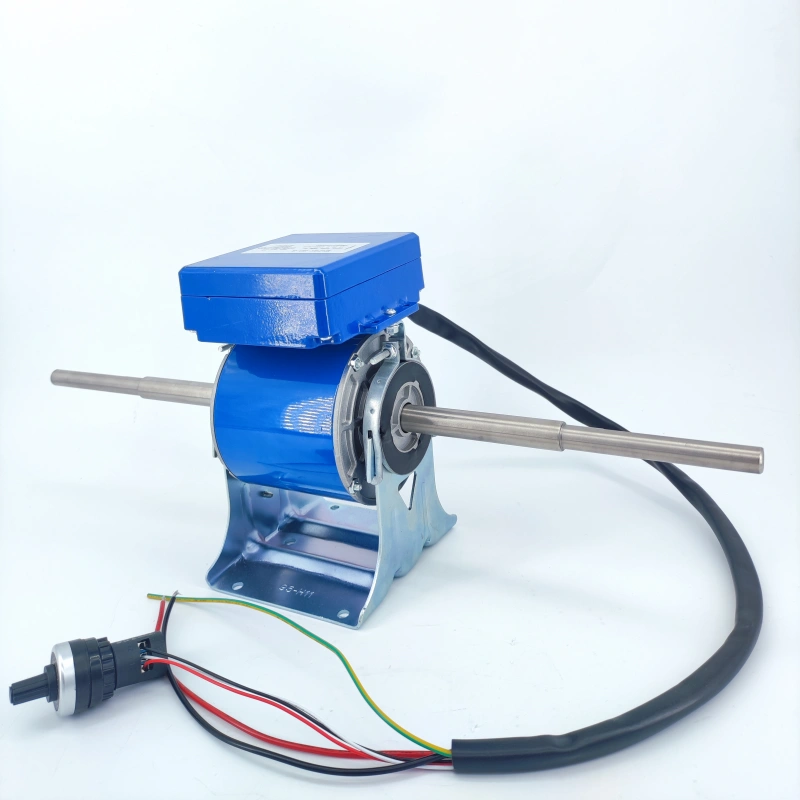
The rise of brushless DC motors (BLDC) is essentially their all-round surpassing of traditional brushed motors in terms of structural design, performance, and operating costs. Traditional brushed motors realize current commutation through the mechanical contact between brushes and commutators. This structural defect makes it difficult for them to make breakthroughs in core indicators such as efficiency, service life, and reliability. In contrast, brushless DC motors adopt electronic commutation technology, completely abandoning brushes and commutators, which fundamentally solves the inherent problems of traditional motors and perfectly meets the core demands of modern industries for motors, namely “high efficiency, long service life, and low energy consumption”.
First of all, the ultra-long service life and low maintenance cost are the “core trump cards” of brushless DC motors. The brushes and commutators of traditional brushed motors will wear out continuously during high-speed friction, with a general service life of only 1,000 to 3,000 hours. In industrial scenarios with continuous operation, it may be necessary to shut down the machine to replace the brushes every month, which not only increases maintenance costs but also seriously affects production efficiency. Brushless DC motors, however, realize electronic commutation through Hall sensors and controllers, without any mechanical contact and wear parts. Their service life can reach 10,000 to 30,000 hours, which is 5 to 10 times that of traditional brushed motors. Taking household vacuum cleaners as an example, products using brushed motors usually experience power attenuation after 1 to 2 years of use, while those equipped with brushless motors can have a service life extended to 5 to 8 years, with almost no maintenance required during this period, greatly reducing the user’s operating costs.
Secondly, the high-efficiency and energy-saving characteristics make them more competitive against the backdrop of energy shortages. The brush friction of traditional brushed motors will cause 10% to 20% energy loss, and the commutation sparks will also cause electromagnetic interference, further reducing energy utilization efficiency. Their comprehensive efficiency is usually between 60% and 75%. Due to the elimination of mechanical friction loss, the energy conversion efficiency of brushless DC motors can be increased to 85% to 95%. Under the same power output, their power consumption is more than 30% lower than that of traditional brushed motors. Taking the conveyor belt motor of an industrial assembly line as an example, a 5-kilowatt brushless DC motor operates for 8,000 hours a year. Calculated at an industrial electricity price of 0.6 yuan per kWh, it can save 7,200 yuan in electricity costs per year compared with a brushed motor of the same power. In the auxiliary motor system of new energy vehicles, the high-efficiency feature of brushless motors directly improves the cruising range of the vehicles, making them the core choice of automobile manufacturers.
The excellent control performance and operation stability enable them to adapt to more complex scenarios. The speed regulation of traditional brushed motors relies on changing the armature voltage, which has low speed regulation accuracy and slow response speed, making it difficult to meet the needs of precise control. Brushless DC motors can realize precise control of speed and torque through vector control technology, with a wide speed regulation range of up to 1:1000, and the response time from stable low-speed operation to instantaneous high-speed start is only a few milliseconds. In the field of UAVs, the precise control capability of brushless motors ensures the stable hovering and flexible steering of UAVs; in medical equipment, their low vibration and low noise characteristics meet the strict requirements of surgical instruments for operation stability. In addition, the commutation sparks generated by traditional brushed motors will interfere with surrounding electronic equipment, while brushless motors have better electromagnetic compatibility during operation and can be applied in fields such as communications, aerospace, which have extremely high requirements for the electromagnetic environment.
The gradual elimination of cost disadvantages has accelerated their popularization. In the early days, due to the high cost of controllers and Hall sensors, the price of brushless DC motors was 2 to 3 times that of traditional brushed motors, which restricted their application in the mid-to-low-end market. With the development of semiconductor technology, the cost of motor controller chips has dropped significantly. At the same time, large-scale production has reduced the overall price of brushless motors by more than 50% compared with ten years ago. In many application scenarios, although the initial purchase cost of brushless motors is slightly higher, combined with their ultra-long service life and energy-saving advantages, the full-life cycle cost is already lower than that of traditional brushed motors. For example, after using brushless motors in the exhaust fans of commercial kitchens, the electricity and maintenance costs saved each year can cover the initial cost difference, showing significant long-term economic benefits.
Of course, in some simple scenarios that are extremely cost-sensitive and have low control requirements (such as toys and small fans), traditional brushed motors still have a certain living space. However, from the perspective of technological development trends, with the continuous upgrading of motor control technology, the application boundary of brushless DC motors is constantly expanding. From daily power tools to large industrial equipment, from consumer electronics to the new energy industry, brushless DC motors are promoting the technological innovation of the entire motor industry with their irreplaceable advantages, and have become an indispensable core power component in modern industrial production and daily life.