 English
  French
  German
  Spanish
  Portuguese
  Dutch
Dutch  Italian
  Russian
  Chinese
  Japanese
  Korean
  Indonesian
  Thai
Thai  Vietnamese
  Arabic
  Turkish
  Hebrew
  Hindi
Hindi 
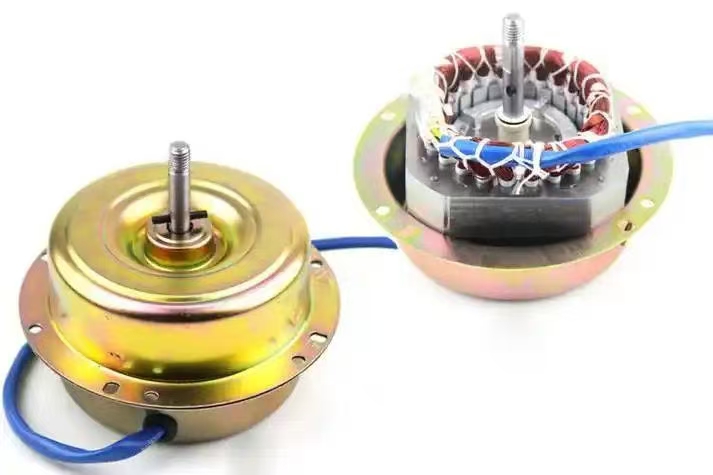
There are many types of AC motors, but their main components and working principles have similarities. Here, we will take the most common three-phase asynchronous motor (or induction motor) as an example for detailed explanation, as it occupies the vast majority of industrial applications.
AC motors are mainly divided into two core components: stator and rotor. They are separated by an air gap and have no direct electrical connection.
1、 Stator
The stator is the stationary part of a motor, and its core function is to generate a rotating magnetic field.
The main components include: stator core Function: To form a magnetic circuit, guide and concentrate magnetic fields. Structure: It is made up of many circular silicon steel sheets with grooves punched and stacked to reduce eddy current losses.
These slots are used for embedding stator windings.
stator winding: Function: When AC power is applied, a rotating magnetic field is generated.
This is the ‘heart’ of the motor,Structure: Made of insulated copper or aluminum wire wound according to specific rules, embedded in the slot of the stator core.
A three-phase motor has three independent windings (U, V, W), which are distributed at an electrical angle of 120 degrees apart in space. Base:Function: Fix and support the stator core and winding, and protect the internal structure.
Usually equipped with heat dissipation ribs to help the motor dissipate heat. End cover. Function: To support the rotor bearings, protect the interior of the motor, and ensure concentricity between the stator and rotor.
2、 Rotor
The rotor is the rotating part of the motor, which generates induced current and electromagnetic torque under the cutting of the stator rotating magnetic field, thereby driving the load to rotate.
According to different structures, the rotors of AC asynchronous motors are mainly divided into two types:
A. Squirrel cage rotor
This is the most common and sturdy type.
Rotor core: also made of stacked silicon steel sheets, with grooves punched on the surface.
Rotor winding: It is not a traditional insulated wire, but is composed of rotor bars and end rings.
Rotor conductor: It is a copper or aluminum strip inserted into the rotor slot.
End rings: located at both ends of the rotor, short-circuit all conductive bars.
Overall shape: resembling a squirrel cage, hence the name.
For small and medium-sized motors, molten aluminum is usually cast directly into the rotor slot to form guide bars, end rings, and even cooling fan blades in one go.
B. Wound rotor
Used in situations where high starting torque or speed regulation is required (such as cranes, large fans).
Rotor core: Similar to squirrel cage type.
Rotor winding: a three-phase symmetrical winding made of insulated wires, with the same number of poles as the stator winding.
The winding is usually connected in a star shape.
Collecting rings and electric brushes: The three output terminals of the rotor winding are connected to the three collecting rings and connected to external starting resistors or speed control devices through electric brush devices.
After starting, the electric brush can be lifted and the winding can be short circuited through a short-circuit device to improve operating efficiency.
3、 Other key components
Air gap: The tiny air gap between the stator and rotor.
It is crucial:
The smaller the air gap, the better the electromagnetic coupling, and the higher the motor efficiency and power factor.
However, a small air gap can lead to manufacturing difficulties and possible friction during operation.
Bearing: Installed on the end cover, supporting the rotor shaft to ensure smooth rotation.
Cooling fan: usually installed at the non load end of the rotor shaft, with an external hood for forced ventilation and heat dissipation.
Junction box: located on the outside of the machine base, used to connect power lines and internal windings of the motor (such as star or delta connections).
