 English
  French
  German
  Spanish
  Portuguese
  Dutch
Dutch  Italian
  Russian
  Chinese
  Japanese
  Korean
  Indonesian
  Thai
Thai  Vietnamese
  Arabic
  Turkish
  Hebrew
  Hindi
Hindi 
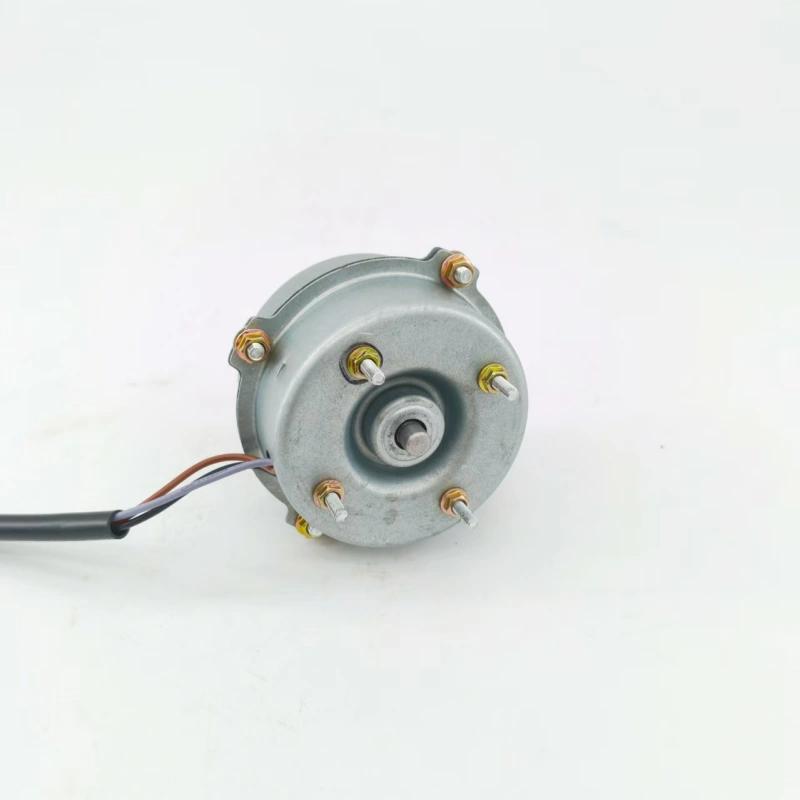
The unstable rotation speed of DC motors is caused by complex factors involving multiple links such as power supply, machinery, electromagnetism, and control. The specific causes and targeted solutions are as follows:
I. Abnormal Power Supply and Power Supply System: “Source Failure” of Energy Input
The rotation speed of a DC motor is directly related to the armature voltage (in line with the formula n=(U-IaRa)/(CeΦ), where n is the rotation speed, U is the armature voltage, Ia is the armature current, Ra is the armature resistance, Ce is the electromotive force constant, and Φ is the excitation flux). Voltage fluctuation or current abnormality in the power supply system is the primary inducement for unstable rotation speed.
Common problems include: the input voltage fluctuates by more than ±10% due to changes in power grid load; the wire diameter of the power cord is too small, leading to excessive line loss when the current is large, resulting in a “voltage drop”; the power supply filter capacitor ages and fails, unable to filter out AC ripples, causing the armature to obtain pulsating voltage. For example, if a small DC motor uses an inferior switching power supply, obvious rotation speed jitter will occur when the ripple coefficient exceeds 5%.
Solutions: Prioritize the selection of linear power supplies or high-frequency switching power supplies with a voltage regulation accuracy of within ±0.5% to ensure stable armature voltage; select copper core wires with sufficient wire diameter according to the rated current of the motor, and control the line voltage drop within 0.5V; regularly detect the capacitance value of the power supply filter capacitor, replace aging and failed components, and if necessary, add a secondary filter circuit to improve the purity of the power supply.
II. Mechanical Structure Faults: “Physical Obstacles” in Power Transmission
Wear, jamming, or assembly deviation of mechanical components will lead to uneven load of the motor, thereby causing rotation speed fluctuation. Core problems include: insufficient oil and wear of bearings lead to fluctuating friction torque, and in severe cases, the “bore sweeping” phenomenon (friction between the armature and the stator) occurs; the transmission components such as couplings and pulleys are eccentrically installed, generating periodic radial forces; the load end is jammed (such as valve jamming, poor gear meshing), resulting in sudden changes in load torque.
Taking the conveyor belt drive motor as an example, if the parallelism deviation of the pulley exceeds 0.1mm/m, the belt tension will change periodically, and the motor rotation speed will fluctuate accordingly. Solutions: Establish a regular maintenance mechanism, lubricate the bearings every 2000 hours of operation, and replace them in a timely manner when the wear exceeds the standard; use a dial indicator to calibrate the coaxiality and parallelism of the transmission components, and control the error within 0.05mm; install a torque sensor at the load end to monitor the load change in real time and avoid overload operation.
III. Faults of Motor Body and Electromagnetic System: “Performance Attenuation” of Core Drive
Faults in the internal electromagnetic circuit or structural components of the motor will directly damage the rotation speed stability, mainly manifested as: aging of the armature winding insulation leads to inter-turn short circuit, reducing the armature resistance Ra, increasing the current Ia, and abnormally increasing the rotation speed; open circuit or poor contact of the excitation winding leads to a decrease in the excitation flux Φ and a sharp increase in the rotation speed (risk of “runaway”); wear of the commutator surface or poor contact of the carbon brush causes intermittent armature current, resulting in rotation speed pulsation.
To address such problems, professional testing methods are required to locate the faults: use a megohmmeter to detect the insulation resistance of the armature winding, and re-impregnate it with paint for insulation treatment when it is lower than 0.5MΩ; measure the on-off of the excitation winding with a multimeter, and polish the terminal block and fasten it when the contact is poor; regularly polish the commutator surface with fine sandpaper, adjust the carbon brush pressure (usually 0.15-0.25MPa), and ensure that the contact area exceeds 90%.
IV. Failure of Control Circuit and Feedback System: “Closed-Loop Breakage” of Rotation Speed Regulation
Modern DC motors mostly adopt PID closed-loop control. Abnormal rotation speed feedback signals or mismatched controller parameters will lead to regulation failure. Common problems include: loose installation of rotation speed sensors (such as encoders and tachogenerators) leads to pulse loss of feedback signals; unreasonable setting of controller PID parameters, excessive proportional gain is prone to oscillation, and too long integral time leads to response lag; damage to components such as relays and thyristors in the control circuit leads to failure of armature voltage regulation.
Solutions: Fix the rotation speed sensor with an anti-loosening structure, ensure that the signal transmission line has good shielding to avoid electromagnetic interference; re-tune the PID parameters through the “attenuation curve method” to match the system response speed with stability; regularly conduct on-off detection on the control circuit, replace failed components, and if necessary, add redundant control modules to improve reliability.
In summary, solving the problem of unstable rotation speed of DC motors requires following the principle of “source investigation and hierarchical processing”, comprehensively detecting from four dimensions of power supply, machinery, electromagnetism, and control, formulating targeted solutions based on the motor operating conditions, and establishing a regular maintenance mechanism to fundamentally ensure the rotation speed stability and improve the operation quality of the equipment.
