Hindi
Hindi  English
  French
  German
  Spanish
  Portuguese
  Dutch
Dutch  Italian
  Russian
  Chinese
  Japanese
  Korean
  Indonesian
  Thai
Thai  Vietnamese
  Arabic
  Turkish
  Hebrew

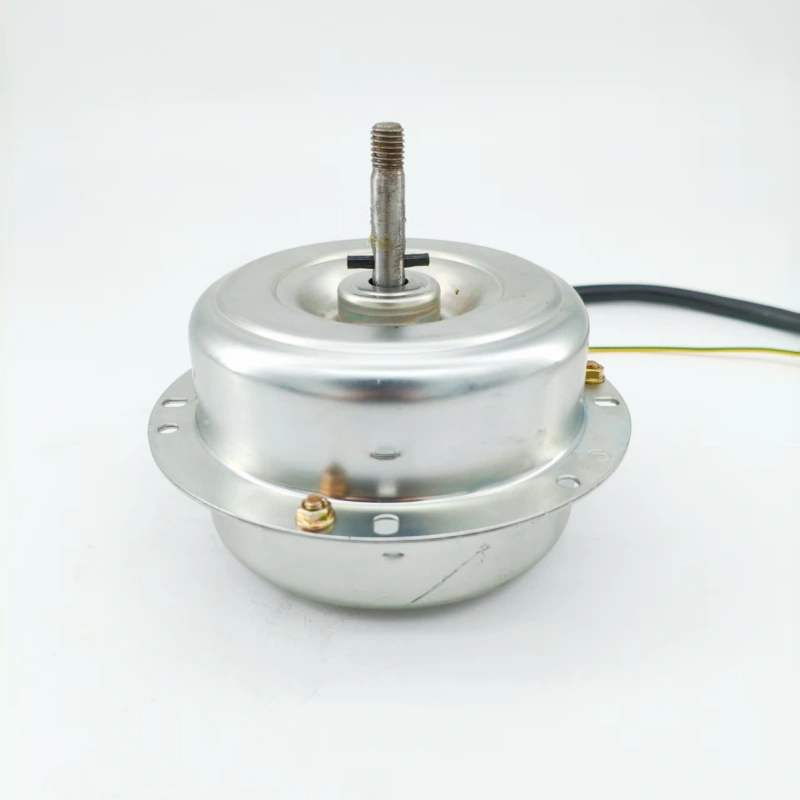
This is a very good question and a core concept in motor applications. No, the speed of the AC motor is not constant, but it can be maintained at a constant speed under specific loads through technical means.
1.What determines the speed of an AC motor?
For the most common AC asynchronous motor (induction motor), its speed is mainly determined by two factors:
Power frequency (f): This is the primary factor determining the rotational speed.
Number of motor poles (p): The number of poles in the internal winding of a motor.
The theoretical formula for synchronous speed is: n ₛ=60 × f/p
Among them, n ₛ is the synchronous speed (unit: revolutions per minute, RPM), f is the power frequency (Hertz, Hz), and p is the logarithm of poles.
For example:
In China (50Hz power grid), the synchronous speed of a 4-pole motor (p=2) is: 60 × 50/2=1500 RPM.
In the United States (60Hz grid), the same motor speed is: 60 × 60/2=1800 RPM.
Key point: For asynchronous motors, the actual rotor speed (n) is always slightly lower than the synchronous speed (n ₛ), and this difference is called the “slip rate” (s).
Without slip, the motor cannot generate torque.
So the actual speed will slightly decrease with the increase of load.
2.Why do we feel that many AC motors have a “constant speed”?
This is because in traditional application scenarios:
The frequency of the power grid is fixed (such as 50Hz or 60Hz).
The number of poles in a motor is a fixed physical structure.
Under these two “fixed” conditions, the synchronous speed of the motor is fixed.
Although there may be slight changes in the actual speed when the load changes (slip rate changes, usually around 1% -5%), for many devices such as fans, water pumps, compressors, etc., this change can be ignored, so we feel that it is running at a “constant speed”.
3.Under what circumstances does the AC motor not have a constant speed?
When we need to change the motor speed, we must break the two “fixed” conditions mentioned above:
Using a frequency converter: This is the most mainstream method in modern industry.
The frequency converter continuously and smoothly adjusts the speed by changing the power frequency (f) supplied to the motor.
For example, adjusting the frequency from 50Hz to 25Hz will halve the synchronous speed of the motor.
Variable frequency drives make AC motors excellent speed regulating motors, widely used in elevators, precision machine tools, textile machinery, and more.
Changing the number of pole pairs (pole changing motor): By changing the connection of the internal winding of the motor, the number of pole pairs (p) can be changed to obtain a limited number of fixed speeds (such as dual speed motors and three speed motors).
Commonly used in simple speed regulation scenarios, such as machine tools, cranes, etc.
Severe load changes: For asynchronous motors that start directly, when the load suddenly increases significantly, their speed will noticeably decrease.
4. Another important type of AC motor: synchronous motor
There is also an AC synchronous motor (with a rotor composed of permanent magnets or DC excitation).
Its speed is strictly equal to the synchronous speed (n ₛ), and as long as the frequency remains constant, regardless of how the load changes, its speed is absolutely constant (without overloading).
Application: Commonly used in situations where precise synchronization of speed and power frequency is required, such as generators in power plants, large compressors, high-end textile machinery, and certain robot joints (usually used in conjunction with drivers).