English
  French
  German
  Spanish
  Portuguese
  Dutch
Dutch  Italian
  Russian
  Chinese
  Japanese
  Korean
  Indonesian
  Thai
Thai  Vietnamese
  Arabic
  Turkish
  Hebrew
  Hindi
Hindi 

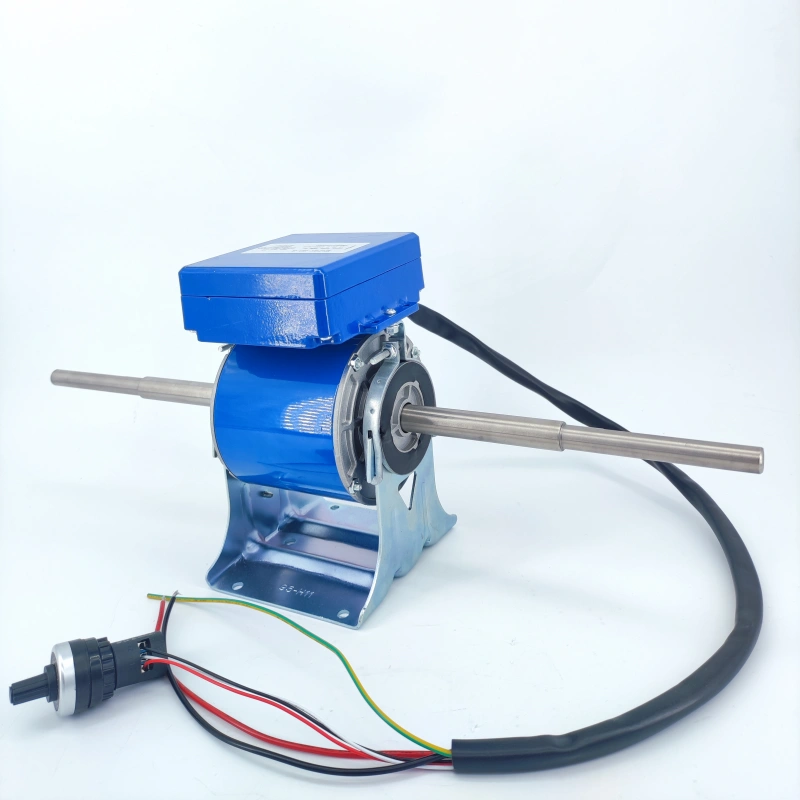
Only synchronous motors have a relatively constant speed when the load changes;
Ordinary asynchronous motors (the most commonly used AC motors) experience a slight decrease in speed as the load increases, rather than being absolutely constant.
1. In depth understanding of physical principles: Why does speed change or remain constant?
To understand this issue, it is necessary to introduce a concept: slip rate (s), which is the key to understanding AC asynchronous motors.
Asynchronous motor (induction motor) – relies on “slip” to generate torque
This is the most widely used motor in industry.
Principle: The stator generates a rotating magnetic field, and the rotor induces current by cutting magnetic field lines. The induced current is subjected to force in the magnetic field, thereby driving the rotor to rotate.
Core relationship: The rotor must ‘chase’ the magnetic field, but it can never catch up.
If the rotor speed (n) equals the magnetic field speed (n ₀, i.e. synchronous speed), the rotor conductor will no longer cut the magnetic field lines, the induced current will disappear, and the torque will also disappear.
Formula: Slip rate s=(n ₀ – n)/n ₀
Dynamic process during load changes:
When the load increases: the load torque is greater than the motor electromagnetic torque, and the rotor speed n begins to decrease.
2. A decrease in speed means that the difference between n ₀ – n (i.e. slip) increases.
3. An increase in slip means that the speed at which the rotor cuts magnetic field lines increases, and the induced current in the rotor also increases.
4. As the rotor current increases, the electromagnetic torque of the motor also increases.
5. Ultimately, when the electromagnetic torque increases to be equal to the new load torque, the motor regains balance at a lower speed than before.
Conclusion: The speed of asynchronous motors is inherently a function of the load.
The speed variation is the intrinsic mechanism by which it generates torque to balance the load.
Without speed change (i.e. no slip), it has no torque output.
2. The influence of load type on speed stability
In practical applications, the impact on speed varies depending on the way the load changes.
Constant torque load (such as conveyor belts, cranes):
The load torque remains basically unchanged.
For asynchronous motors, this means that the slip rate remains basically unchanged and the speed changes very little.
For synchronous motors, the speed remains completely unchanged.
Fan and pump loads (such as fans and water pumps):
The load torque is proportional to the square of the rotational speed (T ∝ n ²).
This type of load changes dramatically.
If an asynchronous motor is directly driven, the change in the opening of the air door will cause significant fluctuations in the motor current and speed.
This is also why variable frequency speed regulation has a significant effect on energy-saving applications of fan and water pumps – because it can actively adjust the speed according to demand, rather than passively changing the speed with the wind door.
Impact loads (such as crushers and rolling mills):
The load increases dramatically in an instant.
Even synchronous motors can experience brief speed fluctuations and oscillations due to the rapid increase in power angle before resuming synchronization.
And asynchronous motors will instantly lose speed, relying on their own mechanical characteristics to recover.
In this operating condition, it is necessary to rely on the fast response of the frequency converter or servo drive to maintain absolute speed stability.