 English
  French
  German
  Spanish
  Portuguese
  Dutch
Dutch  Italian
  Russian
  Chinese
  Japanese
  Korean
  Indonesian
  Thai
Thai  Vietnamese
  Arabic
  Turkish
  Hebrew
  Hindi
Hindi 
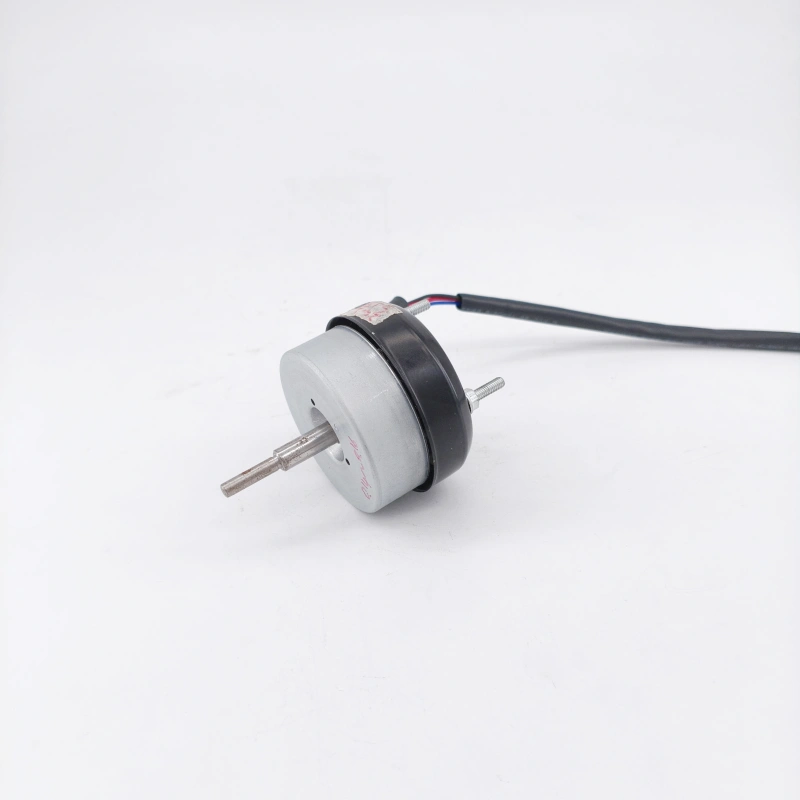
Of course. Increasing the speed of a DC motor is a common and feasible requirement, usually achieved through the following methods:
1. Increase the armature voltage (the most direct and effective method)
Principle: The speed of a DC motor is proportional to the armature voltage (ignoring load and losses).
The simplified formula is: n ∝ (V – Ia * Ra)/Φ, where V is the armature voltage, Ia is the armature current, Ra is the armature resistance, and Φ is the magnetic field flux.
Operation: Use adjustable power supply, DC speed regulator (such as PWM controller) or boost converter to increase the voltage applied across the armature.
Notes:
Insulation level: Ensure that the voltage does not exceed the rated values of the motor insulation and commutator.
Heating: Current may increase, temperature rise needs to be monitored to prevent overheating.
Mechanical strength: Excessive rotational speed may cause damage to the mechanical structure of the rotor (centrifugal force).
2. Weaken the magnetic field (applicable to separately excited or parallel excited motors)
Principle: The rotational speed is inversely proportional to the magnetic field flux Φ.
Reducing the excitation current can weaken the magnetic field and thus increase the rotational speed.
Operation: For motors with independent excitation windings, demagnetize by reducing the excitation current (such as using a variable resistor or adjusting the excitation power supply).
Notes:
Speed limit: A weak magnetic field can lead to extremely high speeds, which may cause loss of control (“runaway”), especially for series excited motors.
Reversing problem: Weak magnetic field may worsen commutation and increase sparks.
Only applicable to: separately excited, parallel excited, or permanent magnet DC motors (permanent magnet motors have a fixed magnetic field and generally cannot have weak magnetism unless specially designed).
3. Reduce the load torque
Principle: The actual speed is affected by the load.
Reduce mechanical load, and the motor can operate closer to the no-load speed.
Operation: Check the transmission system to reduce friction, inertia, or working resistance.
4. Use gearbox or pulley system (mechanical method)
Principle: It does not change the speed of the motor itself, but increases the speed of the output shaft through the transmission ratio.
Operation: Increase the transmission mechanism (such as increasing the diameter of the driving wheel or decreasing the diameter of the driven wheel).
Attention: This will reduce the output torque.
5. Choose the appropriate type of motor
Series excited DC motor: naturally has “soft characteristics”, with high speed under light load (but unstable speed under load changes).
Brushless DC motor (BLDC): When combined with an efficient controller, it can typically adjust speed over a wider range.
6. Advanced control technology
Closed loop speed control system: using speed feedback (such as encoders, speed measuring generators) and PID controllers to accurately control voltage to achieve stable high-speed operation.
Weak magnetic control: Simultaneously adjust the armature voltage and magnetic field above the base speed to achieve wide range speed regulation.
